
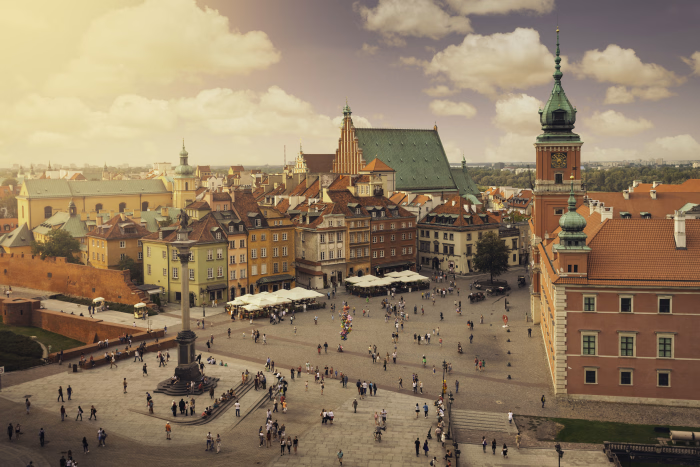
Every great city is a palimpsest, a scroll where one story is written over another. To truly understand a destination, one must step away from the polished main avenues and walk the storied paths of its oldest neighborhoods. These areas are the living museums of a city, where centuries of history linger in the cobblestones, the architectural details, and the unique local pace of life. They offer a deep dive into the cultural soul that birthed the modern metropolis.
The Medieval Heart of London
London’s history is famously vast, but its earliest beginnings are best captured in the area known as the City of London. While this financial hub appears hypermodern, its ancient lanes and alleyways still follow their medieval patterns. Walk down Cheapside or Fleet Street and you are walking the routes of Roman roads and Saxon markets. The neighborhood surrounding the Tower of London, a thousand year old fortress, is particularly evocative. Within its shadowed walls, one can almost hear the echoes of royal intrigue and historical conflict. Exploring these sections of London allows travelers to trace the evolution of England’s capital from a small trading post on the Thames to the global power it is today. Seeking out historical pubs or small, tucked away churches can enrich the experience, providing intimate windows into the past that larger museums cannot replicate.
Dublin’s Literary and Political Echoes
Across the Irish Sea, Dublin offers a rich tapestry of literary and political history woven into its central neighborhoods. The area around Trinity College and the Dublin Castle grounds speaks to the city’s complex colonial past and its emergence as an independent cultural force. To the south, the Georgian architecture of Merrion Square and Fitzwilliam Square represents an era of aristocratic elegance and intellectual fervor, where names like Oscar Wilde and W.B. Yeats made their mark. The Liberties, an older and more working class district, reveals a different side of the city. Known for its traditional markets and strong local identity, it provides a gritty, authentic counterpoint to the city’s grander historical zones. This variety within a relatively small area makes exploring Dublin intensely rewarding.
The Old Town of Edinburgh
Edinburgh is perhaps the easiest city to read historically, thanks to the dramatic geography that splits it into the medieval Old Town and the Georgian New Town. The Old Town, a UNESCO World Heritage site, is dominated by the Royal Mile, a thoroughfare running from Edinburgh Castle down to Holyrood Palace. The narrow closes and wynds that branch off the Mile were once densely populated and often dangerous, but today they offer a fascinating glimpse into the cramped living conditions and social structure of the city’s early inhabitants. Every bend in the road, every carved inscription on a tenement wall, has a story attached to it. A journey that calls on multiple storied cities is often best managed on a British Isles cruise, as it handles the logistics of transportation while allowing passengers ample time for in depth exploration during the day.
Finding the Roman Legacy in Southampton
While many historic neighborhoods are famous for medieval or Renaissance history, others reveal Roman or even earlier influences. Southampton, a major port city, has surprisingly well preserved medieval walls and gatehouses that date back to the 13th century. However, its historical significance began much earlier, when the Romans established a settlement nearby. Traces of this distant past are uncovered regularly, showing that the city has been a vital point of connection and trade for two millennia. Touring these preserved fortifications offers a unique way to contrast the city’s ancient defensive needs with its modern role as a welcoming global port.
Exploring these enduring neighborhoods is about more than just sightseeing; it’s about experiencing the layered identity of a city. It requires slowing down, paying attention to the small details, and appreciating the deep roots that anchor a city’s vibrant present to its remarkable past. These spaces remind us that history is not just confined to books; it’s alive in the brick and mortar, waiting to be discovered just off the main road.




More Stories
Choosing a Resort That Connects Modern Travelers With Ancient Tranquility
Experience the Ultimate Desert Safari Dubai with Thrilling Dubai Dune Buggy Tours
Daegu After Sunset: Time to Explore the City’s Nightlife